
Scattershot Symphony Podcast
Series 1
Episode #36: You Are The Orchestra
A Walk In The Woods
Episode #36:
You Are The Orchestra …
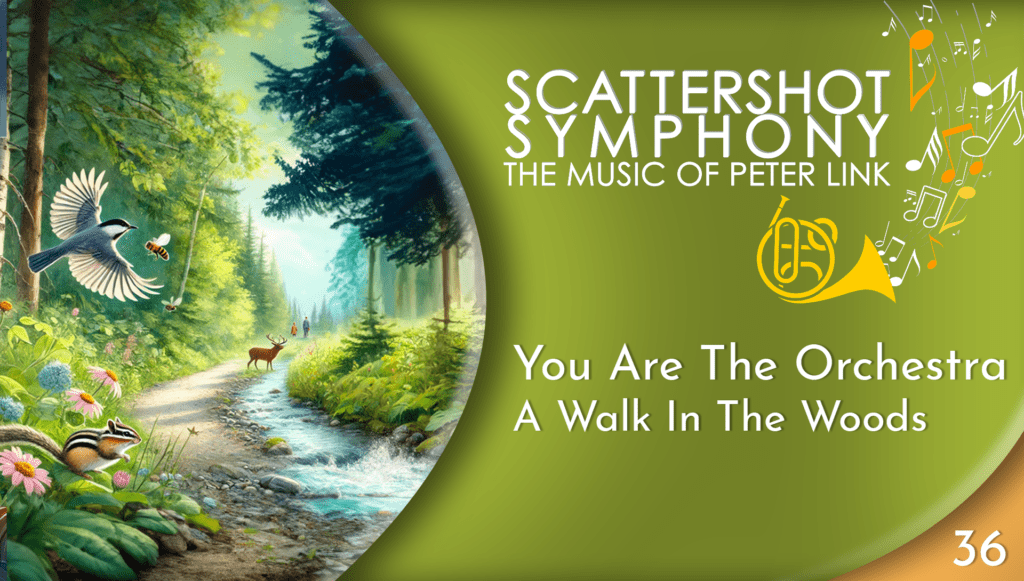
… A Walk In The Woods
Listen to the Podcast Episode
View the Transcript
Scattershot Symphony #36
You Are The Orchestra
A Walk In The Woods
Welcome to:
Scattershot Symphony
The Music of Peter Link
(That’s me.)
This week being the thirty-sixth episode of this podcast, I prefer to let the music do the talkin’. However, if you need to know more about me, please visit Wikipedia.com – Peter Link.
This episode is entitled
You Are The Orchestra
A Walk In The Woods
The phone rang. I picked it up and the lady on the other end said, “Hi, my name is Deb Hensley and I am the director of the Creative Arts program at Camp Newfound Owatonna. I was told that you were the one to call to get some help on a problem I’m facing. I’m looking for a teacher to put together a music class for this summer’s creative arts program at camp. The group that was going to teach it just fell through and I’m wondering if you might know someone who might be interested.”
Long story short, needing a vacation, I took the job. Wife, Julia, and I hadn’t had a vacation in far too long. A week or so at this camp in the cool state of Maine woods by a lake in August seemed to totally make sense. I had taught there 20 or so years ago and hauled my son, Dustin, back-and-forth for about seven years to camp every summer from NYC. I thought to myself. “This could be an easy gig and the timing is perfect.”
I would teach two classes, one in the morning and one in the afternoon, to six people per class who had already signed up for the music class that fell through.
I needed to come up with an approach that would not disappoint the 12 people who had already signed up.
All I knew about the 12 people I would teach, according to Deb Hensley, was that each of them could at least carry a tune. Beyond that, I had no idea of the abilities of the 12 people coming together. How do you make these classes interesting to people whose abilities possibly range from music appreciators to music professionals?
When I first signed on for this opportunity to share my thoughts on the subject of music with a group of people that I knew nothing about, it took me several days to figure out how to go about this. The one thing that I felt was most important, was to immediately involve all of them somehow, in the making of music — not just listening to it, or talking about it, but actually creating it together.
The idea then came to me. Finally: “Fundamentals.” Deal with fundamentals. Every artist, no matter what their ability, needs to periodically check in with fundamentals. At the same time, we needed to have fun doing it. There would possibly be a wide disparity between amateur and professional, and the trick would be to not overwhelm the amateur, and at the same time, keep the professional interested and involved.
So my brilliant idea was to write a camp song in the next two months before camp started, and not only teach it to the 12, but also record it in the classes as well. Could I pull this off in seven days, in the 2 1/2 hours per day of each class? A brilliant idea, but, perhaps biting off more than I could chew. Hmm. Perhaps NOT a brilliant idea …
Wife, Julia had just purchased a new Mac laptop. With both a few minor purchases, and some camp provided money for rental, I could foresee that I could actually build, in a small room, a recording studio. With Julia working as my engineer, I would teach and somehow extract a performance from these people by hook or by crook and earn my pay on the last day of camp when we would show the rest of the campers our progress in a show and tell performance.
The wrinkle in my plans came, when about six weeks before camp started, Julia was offered a concert booking in San Francisco that would take her away from our summer vacation for four days in the middle of our work at the camp. I would have to do her engineering job as well as mine, while she was gone. Suddenly, two old enemies, Pressure and Stress entered the picture.
Working with people I did not know, in a room that I had never seen before, with equipment that I was relatively unfamiliar with, turned an opportunity for relaxation into a six week preface of worry and doubt. What had I done? Was I up to this? I knew one thing: I had to get organized like never before.
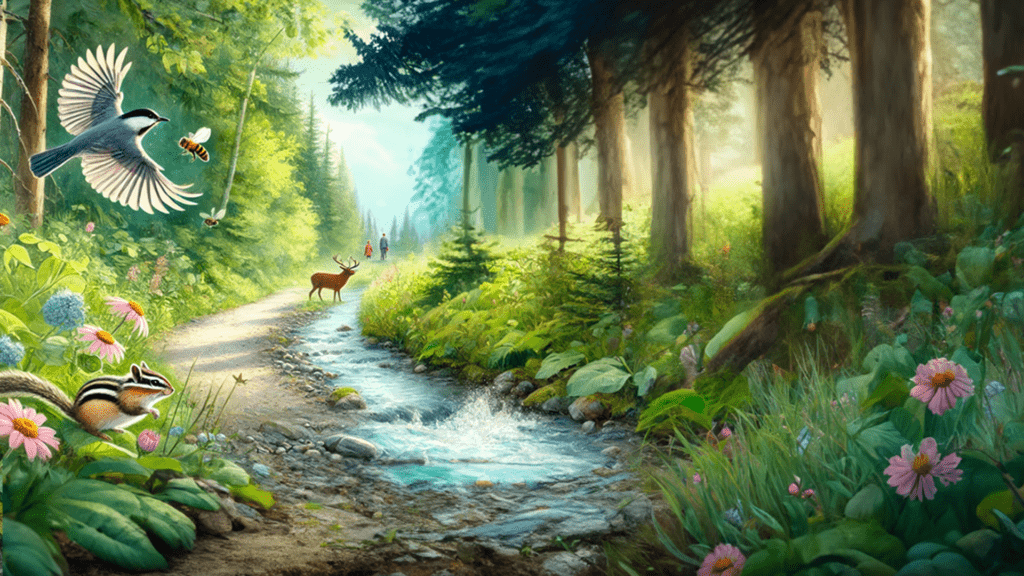
At least I had written the song. After all, since it was camp, Why not a camp song? The idea came. “A Walk In The Woods.” I would somehow create in music, the atmosphere of the woods around this gorgeous lake that I had so enjoyed many years ago.
The song came to me easily. I first wrote the lyrics.
Come with us now
As we take a little walk in the woods
Come with us now
As we take a little walk in the woods
A walk in the woods!
And oh, how the breeze
Whispers through the leaves >>>
This morning
And the sunlight through the trees
Warms the birds and bees
As we trip the light fantastic
Yeah yeah yeah
To the chickadees and bumble bee’s refrain
Doot doot doo
A walk in the woods!
And look!
A weeping willow tree
How sad …
Her branches
Reaching down
Reaching down
Reaching down…
(Then, we could go into a sad string section of 8 Bars — the wind in the willows, followed by …)
A walk in the woods!
But look over there
It’s a bubbling
Wubbling brook
I’d wuv to wet my whistle in your waters
Ooooo ooooo. oooo…
A walk in the woods!
Good day Mr. Monk (disgruntled)
You can call me “Chip”
{If you like}
I’m off to feed my family
{You might say}
“I’m going a little nuts!”
Ho ho ho
Hah hah hah
He he he
A walk in the woods!
(We end with bird calls, woodsy animals, a loon, bugs chattering and a cow just for laughs)
Not exactly a song. Rather, just a little slice of life.
A walk in the woods …
The music was a whole different matter. it needed to be like “Jimmy crack corn, and I don’t care” in it’s simplicity, but when I wrote it, its melodies were simple, but its rhythms were not. Call it a sophisticated camp song.
It also struck me that I could use a pedal bass and a very simple two part piano figure that would pull the rhythm section together once I had the bass part completed. The bass part is one very simple one note bassline throughout. I found a neat little piano countermelody and harmonized it so that, it could play throughout the song … or scene.
One day, while writing the melodies that sat upon the simplest of bassline and accompaniment, I had the idea that the singers could sing and possibly replace both the bass line and the piano part. Also by tapping foot and slapping thighs, and perhaps using breath and claps, we could rehearse and record the entire song using only the elements of the human body. A fun idea …
But then I realized that I had really painted myself into a corner. Instead of making things easier I had made the whole process harder. But it was such an interesting idea. — if I could only pull it off. Aaw what the heck … Why not try?
And so, the title of my class was born.
You Are The Orchestra
I wrote to Deb Hensley the following note: “We will all work together in a recording studio atmosphere. I will provide an orchestrated 2 to 4 minute music demo track — drums, bass, keyboards, (the rhythm section and (the sweetening), the strings, then background vocals, and finally, the lead vocal. It’s a simple, catchy, sometimes silly, foundational piece of music with fun lyrics that will relate to camp audiences. We will, section by section, mimic the orchestra parts with similar sounds produced by the human body … and who knows just what our creative imaginations will come up with.
Again, she bought the idea, but clearly with some reservations. She was in charge of the budget and my rentals of good speakers, excellent mics and a multi headphone amp plus what I already had already offered freely from my own studio arsenal, would stretch her beyond her original budget. But Deb was a tiger at gettin’ things done. She was always great at providing the impossible.
The day finally came that Julia and I packed our hatchback car to the gills with a complete recording studio, bedding for a week, an extra suitcase for her concert necessities to and from San Francisco, AND drove New Jersey, Connecticut, Massachusetts, and New Hampshire to Maine. Miracle of all miracles, we succeeded in setting up the studio in a day, which, by the way, worked perfectly, the first time we turned it all on. That good omen set up an energy of positive vibes that took us cleanly through the week ahead. And we never looked back.
Classes began the next morning. My opening remarks to the first six, all women, went something like this:
“ So, here we are, and here we go: Rhythm, Harmony, and Melody. First, the foundation. Today we start with rhythm. So, what do you think is the fundamental or the foundation of rhythm? (a sea of blank faces)
I suggest, meter. What is meter? OK, let’s consider 4/4 time.
Let’s look at Meter versus Rhythm. Some of you already know all this, but it’s always good to go back to the foundation. What is meter? — meter is the one, two, three, four of it all. (x2) Simple, but oh so powerful. And oh so important! Meter is the foundation. If the foundation is not strong, the building will fall down.
So, then what is rhythm? Rhythm Is the building — that which sits upon the foundation. The part everybody sees… Or in this case, the part that everybody hears.
So, let’s start with meter. Here’s a click track. What is a click track? Meter.
(Music)
Listen to the click track… And tap your foot. Don’t rush. Good. Keep tapping your foot. Don’t ever stop. Now slap your thighs along with your foot. Good. Now, Double time your thigh slaps. Good. Now count. One, two, three, four. Double time your hands. Ready … Go! One and two and three and four and.
Now double time the double time. One E and E,
2 ENE3ENE4ENE Now stop. What have you just done? You have just grounded yourself in the meter. Between your foot, hands, thighs and voice, you have now absorbed the meter into your whole body, your whole being. Pay attention to this until it lives in your bones. When in doubt, Tap your foot.
How do you stay in the groove? How do you not rush? Listen and focus. No matter how simple… Focus… TAP YOUR FOOT. The sin is rushing. We’re talking precision here. Rushing comes from not feeling or acknowledging the inner subdivisions. It comes from tension, excitement, but in the end, it all comes down … to listening.
And the first day went something like that. We learned how to tap our foot and not rush. We learned that meter is the foundation. While tapping and slapping we learned to coordinate other things as well. We learned to count. We learned to “ha” on four. We learned to clap instead of slap … also on four when we said.”Ha.” We learned to coordinate mind and body. We learned to respect the meter.
I received no pushback at all from my students. They dove into the process with a surprising eagerness to learn and coordinate. Even the musicians of the group followed suit.
I explained to them all that, though this was perhaps kindergarten, very soon we would be moving on to sixth grade, then high school, then college then to their master’s degree. By the end of the week, I was hoping that they would all get their doctorate.
And so we moved on to grade 6.
It came out something like this. (Play opening bars)
The beginning of our song.
And then we moved on to the bass part.
But first, I told this story.
“Years ago, I just happened to be producing two different albums for two different female Broadway stars in the same couple of months. Broadway singers were not always my favorite singers to record. Singing in a Broadway house was often about filling the room or hitting the back wall. Consequently, a lot of them over sang.
Pushing too hard often results in pitch problems — a little sharp here and a little flat there. Both women definitely were having trouble in the studio with pitch problems. We tried many things and none of their struggles seem to work. I finally asked them both, at two different times, to go home and listen deeply to their finished orchestrated tracks and learn the bass lines. Sopranos very often sing the melody, and all too often skim along the top of the music instead of getting down into the music. I thought that possibly learning the basslines might clarify for them a better sense of pitch. They both seemed eager to try whatever it would take to solve their respective problems.
Remember that these were separate sessions. Neither woman even knew of the other. So, then I asked them to both come in and sing me the bassline. I did not expect the result.
At two different times, they each came in and said the same thing. “I can’t find the Bass! What does it sound like?” I had to laugh. So, in the studio, I soloed the bass part of the song and taught it to each of them.
Then, once they got that, I would add the piano. At first, they would have trouble maintaining the bass part against the piano. But they got it. They continued to sing the bassline as I added in the rest of the orchestration, instrument by instrument. They were amazed at the intricacies of the arrangement and orchestration. Learning the baseline got them both down into the music. They were both fascinated by the various elements of orchestration and became tuned in to the whole of the music.
Best of all, neither one of them had pitch problems in our work together again. They learned to get down into the music and the harmonies and sonorities of the music better informed their ears and consciousness of true pitch.”
End of story. So, simple as it was we then spent 45 minutes nailing down the bass part and feeling it’s syncopations. Simple, but tricky. Foot taps and thigh slaps made it work.
(Play)
After nailing down the bass part, then we learned the piano part in harmonies and sang it in Doots
(Play)
Then we went to lunch.
After lunch I did the entire lesson over again with the afternoon class of six. Four women and two men.
Total? Two Baritone men, seven altos, and only three Sopranos. Thank God for Julia, a soprano.
By the end of the second day, we had drilled the rhythm exercises to the point where I felt we could record them and produce a firm foundation. We even begin to learn the first short melody section of the song.
I could not decide whether or not I should play the song for each class. Normally, one would always start with, “Here’s how the song goes.” I decided not to because I really wanted to build it from the bottom up, saving the melodies, the lead lines, and harmonies for later learning. This way we would maintain a solid focus in consciousness of the rhythm section.
Getting them to sing the bassline and the piano parts with “doots” proved to be one of the best ideas because it so established their awareness of the band and track since they actually were … the band and track.
Learning the melodies became a much easier task for them. I also decided not to provide them with sheet music on the song. I’ve always thought that sheet music was only a vague representation of a song and learning melodies without the sheet music would always provide greater depth of understanding of how the lyrics worked with the tune. To keep things very simple in this exercise of seven days, I had also decided that, in the interest of limited time, once I understood the level of their talents and experience,
I would stay with only two-part harmonies. Only on rare occasions did I go to a 3rd or fourth part.
In the ensuing, four days the rest of the song was learned and recorded, I watched their confidence grow and their abilities develop. I fell in love with all 12 of these dedicated souls. I found their enthusiasm for learning to often be beyond the professionals that I’ve worked with over the years. There was a joy of accomplishment and a wonder at the idea that even the simplest parts coming together in clever ways was all that it took to make music work. We all laughed our way through over 100 tracks and everyone was always game to make each recorded take better and better… And simply get it right.
Finally, on the last day of rehearsal before our performance, for the 200 other campers, I hoped to find an extra half hour in their busy schedule to put both classes together in the same room and sing together. I thought to myself, “theoretically, this should work.” After all, I taught both classes the same thing. “
But then again, you never know until you try it. Once again, our fearless leader, Deb, totally pulled through and found us a half hour to put all 12 people in our little studio together. 12 instead of six! We also had the multi-track of what they had recorded in the room with us. All 12 sang the song down twice, all together, with their previously recorded voices on track. Suddenly, the sound was so big, and with all 12 singing along with the double tracked recorded voices, we now had ourselves a 36-voice chorus.
That was when I knew that this was really gonna work! Also, Julia had come back to join us and was a great addition and leader for our soprano section.
I stayed up most of the night comping and mixing the tracks in to the best rough mix that I could for our little demonstration.
On the day of, we moved most of the studio down to the camp’s main Lodge, where we would perform the song for our big debut. One of our ladies, Jenny Grace Morris is a voice over actor. I decided to minimize my work at the performance to just being the sound mixer in the room and consequently asked Jenny to do the introductions and to pepper the song with a shout out or two. I wrote her a quick character, introduction, and she just gobbled it up. I staged the song in 12 chairs curved across the stage. They would need to be sitting to slap thighs. I also decided not to have any step out solos, except for one, which I gave to John Kitteridge, who stood well over 6 feet, probably the largest chipmunk in the history of the state of Maine. JOHN also pulled off his big moment with aplome.
That night, our fabulous 12 performed to perfection. We knocked.’em dead! An instant standing ovation, followed by shouts of “Encore, encore!” From my mixing position in the center of the room, I bowed and shouted, “That’s the only song we know!!“To that, someone in the cheering audience replied, “then do it again! “.
And so, we did. We rewound and let her rip! And pulled off, yet again, and nearly perfect performance.
A double triumph!
Years ago, I remember standing with a similar cheering audience opening night at the Winter Garden theater in New York City on Broadway while my beloved Much Ado About Nothing had just been certified as a huge hit. The exhilaration was certainly one of the greatest moments of my life.
The feelings at the end of the second performance of A Walk In The Woods that night in the woods of Maine were similar. The joy, much the same.
Upon arriving back home, I spent a couple of days in my studio, cleaning and balancing and tightening this and that. My postproduction work brought the whole project to a more professional level, but, for me, the rawness of those 12 singers, giving it their all, is the most exciting part of this song. In the end, it’s a camp song. It was made to be sung under the moon in a star filled sky, sitting around a campfire on a beach, by the lake, having just taken a walk in the woods.
Well, there ya’ have it! Episode 36 – You Are The Orchestra
Brought to you by
Camp Newfound Owatonna – Creative Arts Camp
Watchfire Music
Theater Of The Immagination
and
Link Recording Studios
A Walk In The Woods
Music and Lyrics by Peter Link
Our Choir
| Danis Collett — Alto |
| Eliz Crowley — Alto |
| David Sand — Baritone |
| Barbara Sayre — Soprano |
| Jacqui Worden — Soprano |
| Lisa Williams — Alto |
| Patty Turner — Soprano |
| Kim Kilduff — Soprano |
| Carol Fisher — Alto |
| Jenny Grace Morris — Alto & Narrator |
| Joan Ware — Alto |
John Kendrick — Baritone & Mr. Monk
Julia Wade — Soprano
Peter Link — Baritone
I could not possibly end this without a few more thank yous. Aaron Williams – Gold Pants Studio Rentals, Deb Hensley – A most organized and creative soul, Dan and John, from Maitenance – the Masters of heavy lifting, Seth Johnson – Executive Director of Camp Newfound Owatonna – Thank you for all you do and the grace with which you do it. And Julia Wade – My assistant and my boss – You are the essence of Watchfire Music – and you can sing too!
Also, please rate and review us on Apple Podcasts … etc.
A very special thanks also to Stuart Barefoot, our Associate Producer for all your invaluable knowledge and good vibes. And a posthumous thanks to Ludwig Van Beethoven for your opening 4 bars.
Julia
(over playout music)
This podcast is presented with loving care by the staff at Watchfire Music. If you liked what you heard, we got lots more where that came from. In the meantime, you can find the songs you just heard on watchfiremusic.com. There you can purchase the singles or albums and have access to all the lyrics. Also, there you will find all previous podcasts and future scheduling.
If you just became a Scattershot fan, tell your friends and Stay tuned!
About
You Are The Orchestra
A Walk In The Woods
The phone rang. I picked it up and the lady on the other end said,
“Hi, I am the director of the Creative Arts program at Camp Newfound Owatonna. I’m looking for a teacher to put together a music class for this summer’s creative arts program at camp. I’m wondering if you might know someone who might be interested.”
Long story short, needing a vacation, I took the job. A week or so at this camp in the cool state of Maine woods by a lake in August seemed to totally make sense.
The story of how I spent my summer vacation – teaching a music class to 12 dedicated very adult students. The trials and triumphs; the obstacles and revelations.
The building of a song from the ground up and the ultimate joys of performance. A walk in the sunlight; A Walk In The Woods.
A Chorus of Quotes from the Choir!
“This is an amazing WOW!!! LOVED the sounds — especially the wind and the moos!!!!! Just made me feel like I was up on the hilltop in the little studio in the woods having a once-in-a-life opportunity and EDUCATION!!!!” ~Joan
“Glad to have this memory. I loved It ALL!” ~Barbara
“What a treat! It was a delight to be part of, and your not so little touches fill out the song wonderfully. I’ll be proud to play it for my friends :)” ~Danis
“Thank you for writing the song, teaching it to us and introducing us to the inner workings and hidden wonders of a recording studio!” ~Patty
“This was a wonderful learning experience. It is fun to listen for each persons voice and hear the melody and or harmony sung. You were so kind to find a spot for each of our talents.” ~Jenny
“I’d like to express my appreciation again for the workshop at Creative Arts Camp. Experiencing the long, careful process that goes into recording a bit of music was inspiring, and gave me a deeper appreciation of how hard those pop musicians work! It was interesting to meet day after day and see it come together.” ~Eliz
“I certainly learned a lot and have a much greater understanding and appreciation of the recording process. As we drove home we saw a number of large willow trees in New York and Ohio (often 2 or 3 in one yard!) and every time I would burst into song!” ~Jaqui
Want to explore more of Peter’s music? Check out his gorgeous album,
Ode to Joy!
“This is not an album of songs, rather, a mostly instrumental series of impressions on the theme of joy. With each movement, I started with a loved melody from my life, stated it and then let the musings take it from there. I am ever grateful for my connection with the Source of creativity, with the God-given light of joy in my life. It is this light, this joy that I sing about, in all its ramifications. It is my Ode To Joy.” ~Peter Link
Let the Credits Roll!
Click to Learn More About Peter Link and Scattershot Symphony
Peter Link is an American composer, lyricist, music producer, stage director, and presently CEO/Creative Director of Watchfire Music, an on-line Inspirational record company and music store. During his career, Peter has been nominated twice for the Tony Award, including Neil Simon’s The Good Doctor and Joseph Papp’s production of William Shakespeare’s Much Ado About Nothing, won the NY Critics’ Drama Desk Award for Salvation out of which came his first million-selling record, “(If You Let Me Make Love to You Then) Why Can’t I Touch You?”, and worked, mainly as a composer in a number of entertainment mediums ranging from pop music to Broadway, television, ballet, films and Inspirational music.From Wikipedia/Peter Link
Join Peter Link as he presents his life’s work in his podcast, “Scattershot Symphony.” Each episode looks at a different movement in the symphony of his life’s work, which spans some 40 years. Though it’s roughly 90 percent music, Peter manages to regale the listeners with fascinating stories and anecdotes related to his music over the years. Tune in and subscribe to Scattershot Symphony — The Music of Peter Link.
Listen to The Theater Of The Imagination Podcast Series here:
Or, find it in your favorite podcast app:


We’d love to hear from you!
Please share your comments below, and remember:
Click the “Post Comment” button only once!

I loved this episode! What a wonderful adventure for all of you! Peter Link, as usual, you did a wonderful and creative job pulling that experience together for your students!